
Perhaps there is more truth to be found here than the humor suggests.
At school - about 50 years ago - we learned that single-celled organisms do not have sex; they reproduce asexually through cell division [1] and [2]. There is therefore no mixing of DNA programs. That was misleading. Because later I learned that single-celled organisms do exchange (parts of) their DNA with other single-celled organisms [3] of the same species — not for the purpose of reproduction, but for the purpose of optimization: Hey, I've developed a DNA program that makes me immune to virus A. Here, take a copy of this DNA sequence and give me your DNA program that makes you immune to virus B. Then we don't all have to develop it from scratch ...
Yes, billions of years ago, nature discovered the most successful concept ever:
Copying instead of constantly reinventing.
Later, humans adopted this concept, but adapted it. When a Stone Age man saw the sparks created when two stones collided, he invented the principle of making fire. A colleague who saw this wanted to do the same, but he immediately applied for a patent. As a result, he demanded two mammoths in exchange for making fire once. That was a high price, so the chief of the tribe decided that the inventor had to run against a club (and did not survive) and declared the patent invalid because it was in the public interest.
This incident shows that collecting money for copyright depends heavily on how much power you have to enforce it.
The source code for Windows is not accessible to anyone ... except China. They got it. How was Japan able to become a leader in electronics development after World War II? Yes, they copied everything they could get their hands on ...
How much is currently being invested in data centers for AI? By whom? The really big companies. With a lot of influence on politics ... or ... power. Yes, there are court rulings that have ordered some companies to pay for copyright infringements. But what if it turns out that you can earn more money with AI than by collecting copyright fees?
Not to mention that copying is evolutionarily successful.
Or is there anyone else who programmed the bubble sort themselves?
I probably won't live to see it, but I predict that there will be revolutionary changes in patent and copyright law ... possibly not by high courts, but by governments that have recognized the advantages of copying ... and have the power to do so ... the hype surrounding AI may be the final nail in the coffin for copyright nonsense ... ? We'll see.
[1] https://en.wikipedia.org/wiki/Asexual_reproduction
[2] https://en.wikipedia.org/wiki/Fission_( ... ry_fission
[3] https://en.wikipedia.org/wiki/Bacterial_conjugation
AI and copyright issues
Message

I have. It was a fun little exercise. Merge sort too.Or is there anyone else who programmed the bubble sort themselves?
I don't share your optimism, governments will not kill this cancer off of their own volition.I probably won't live to see it, but I predict that there will be revolutionary changes in patent and copyright law ... possibly not by high courts, but by governments that have recognized the advantages of copying ... and have the power to do so ... the hype surrounding AI may be the final nail in the coffin for copyright nonsense ... ? We'll see.
I recall some lecture on the origin of copyright, it said that copyright was created as a proxy for censorship soon after the printing press was invented. British king created printers' guild and gave it monopoly over print. The guild wouldn't print anything inconvenient to the king, and allowing them to hunt down their competition ensured nobody else would either.
AI is getting heavily regulated right now, which means those who already have trained their models will get to keep them, but nobody else will be allowed to train their own models. On top of that, the plebs get the lobotomized, politically correct version, while governments and corporations get the actually useful one.
Now seriously - the (current) legal situation in the US regarding the copyright of programs created with AI (or partially with AI):
Greg K-H shared on mastodon this tweet from Jamie Gaskins (which also includes a link to the PDF):
https://zomglol.wtf/@jamie/116059523957674208
Greg K-H shared on mastodon this tweet from Jamie Gaskins (which also includes a link to the PDF):
https://zomglol.wtf/@jamie/116059523957674208
- Chiitoo
- Ninja Apprentice

- Posts: 3060
- Joined: Sun Feb 28, 2010 5:36 pm
- Location: Sore wa sore, kore wa kore... nanoda.

Did you mean 'toot' (instead of 'tweet'), though unsure if they are still called that? :]pietinger wrote:Now seriously - the (current) legal situation in the US regarding the copyright of programs created with AI (or partially with AI):
Greg K-H shared on mastodon this tweet from Jamie Gaskins (which also includes a link to the PDF):
https://zomglol.wtf/@jamie/116059523957674208
In any case, for the no-JS users:
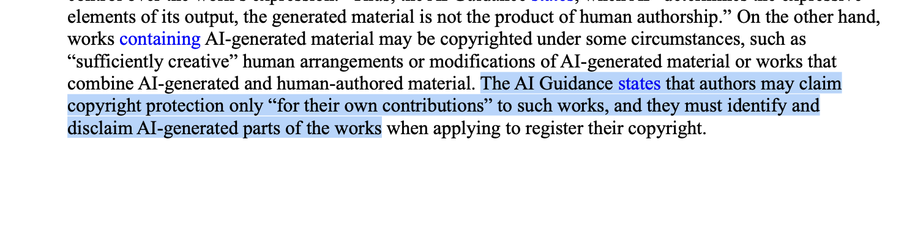
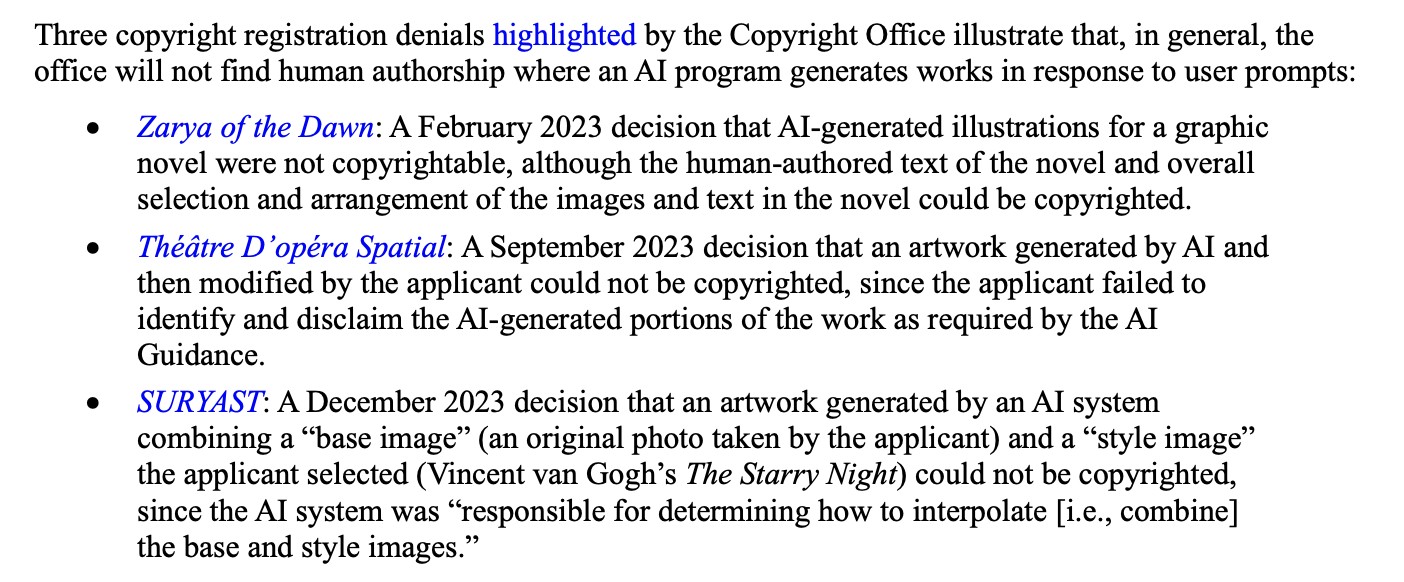
https://zomglol.wtf/@jamie/116059523957674208 wrote:If you use AI-generated code, you currently cannot claim copyright on it in the US. If you fail to disclose/disclaim exactly which parts were not written by a human, you forfeit your copyright claim on *the entire codebase*.
This means copyright notices and even licenses folks are putting on their vibe-coded GitHub repos are unenforceable. The AI-generated code, and possibly the whole project, becomes public domain.
Source: https://www.congress.gov/crs_external_p ... 0922.8.pdf
https://uploads.zomglol.wtf/media_attac ... 26d40d.png
https://uploads.zomglol.wtf/media_attac ... a00d30.png
Kindest of regardses.