
I have a little problem. I run individual linux apps with CoLinux threw ssh. Yet those GNOME / KDE apps do not use the correct settings. GNOME apps need /usr/libexec/gnome-settings-daemon running to use any settings and for KDE I don't even know what the settings daemon is. And I can try what I want I do not get /usr/libexec/gnome-settings-daemon to keep running. I tried it by adding "/usr/libexec/gnome-settings-daemon &" to /etc/conf.d/local.start but it seems that this is bound to the respictive shell and as soon as it terminates the daemon seems to be terminated as well.
So has anybody an idea how ro run gnome-settings-daemon and the KDE settings daemon automatically at startup ?
HOWTO coLinux with gentoo
Message


KDE should not need any daemon, the app should start whatever kde daemons are needed (that is why you would see if you invoke konsole, there are at least 3-4 other processes that it spawns). For gnome, the settings daemon is per user and is only started by gnome-session. you can write a small wrapper script 'gapps' which checks if the daemon is not running and then run it before running the app.Devport wrote:I have a little problem. I run individual linux apps with CoLinux threw ssh. Yet those GNOME / KDE apps do not use the correct settings. GNOME apps need /usr/libexec/gnome-settings-daemon running to use any settings and for KDE I don't even know what the settings daemon is. And I can try what I want I do not get /usr/libexec/gnome-settings-daemon to keep running. I tried it by adding "/usr/libexec/gnome-settings-daemon &" to /etc/conf.d/local.start but it seems that this is bound to the respictive shell and as soon as it terminates the daemon seems to be terminated as well.
So has anybody an idea how ro run gnome-settings-daemon and the KDE settings daemon automatically at startup ?
Code: Select all
#!/bin/bash
settings-pid=`/bin/ps -fu $USER|grep gnome-settings|grep -v grep|awk '{print $2}'`

if [ -z "$settings-pid" ]
then
  /usr/libexec/gnome-settings-daemon &
  sleep 2
fi
exec "$@"I don't think it is suitable for a boot time startup.
You are right. Somehow the same font suddenly appeared small in a KDE app. I adjusted it to be bigger. As for the gnome-settings-daemon :
I forgot to set DISPLAY. Now it works fine by running the daemon at system startup via /etc/conf.d/local.start :
DISPLAY=192.168.0.1:0 /usr/libexec/gnome-settings-daemon &
@all :
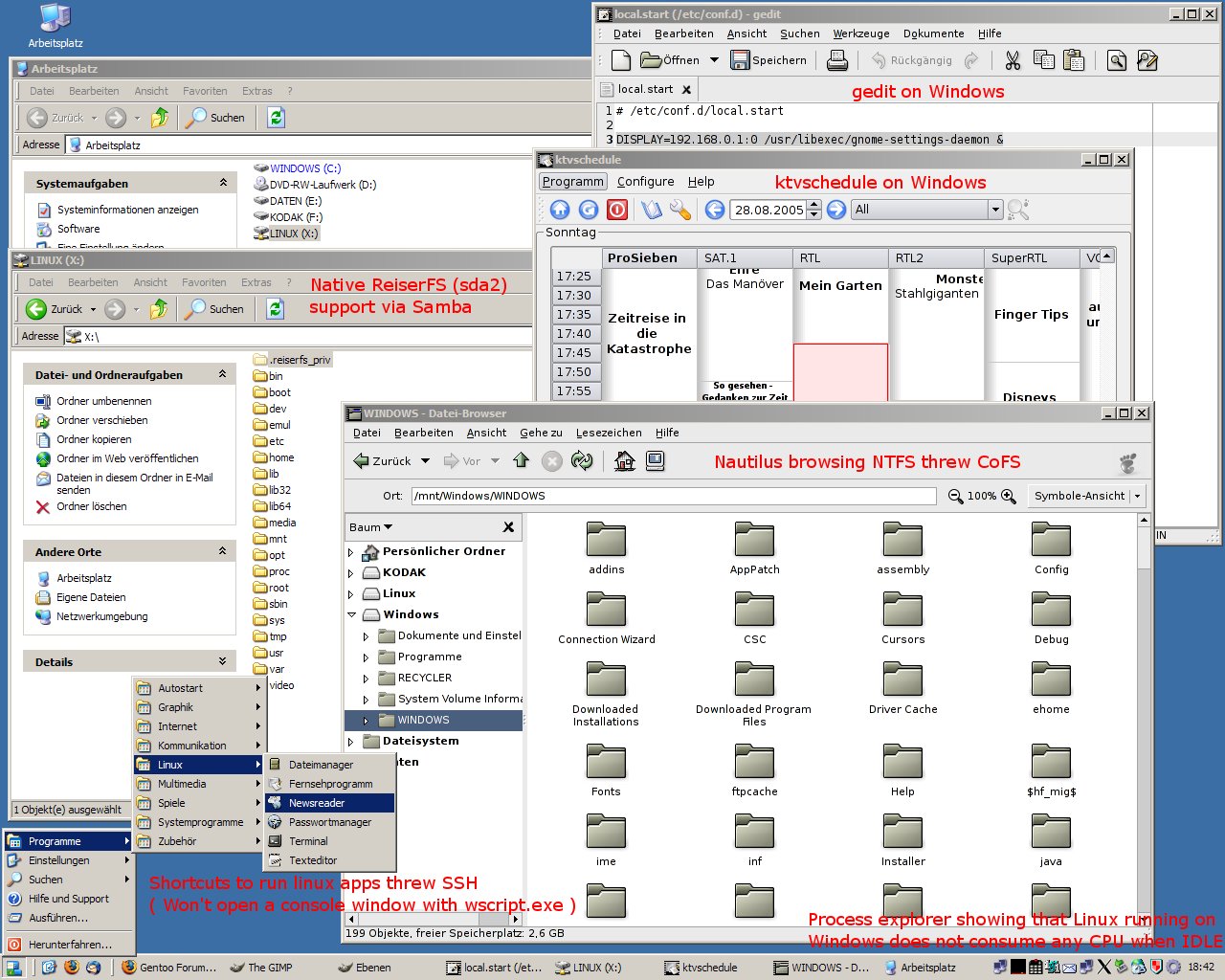
I have added a screenshot showing the great capabilities of CoLinux. Have a look and ask if I can help with setting up Windows shortcuts to linux apps :
Screenshot
Because I have a native amd64 linux installation which can not be run by CoLinux I installed a 32bit gentoo linux and symlinked all important parts to the linux image ( /etc/portage & /root and some others ) which works seemlessly and does not screw up the configuration. Even cut & paste between Windows and Linux apps works. One thing I think would be nice was a Windows app makeing the windows system tray offer freedesktop.org system tray available to X apps.
I forgot to set DISPLAY. Now it works fine by running the daemon at system startup via /etc/conf.d/local.start :
DISPLAY=192.168.0.1:0 /usr/libexec/gnome-settings-daemon &
@all :
I have added a screenshot showing the great capabilities of CoLinux. Have a look and ask if I can help with setting up Windows shortcuts to linux apps :
Screenshot
Because I have a native amd64 linux installation which can not be run by CoLinux I installed a 32bit gentoo linux and symlinked all important parts to the linux image ( /etc/portage & /root and some others ) which works seemlessly and does not screw up the configuration. Even cut & paste between Windows and Linux apps works. One thing I think would be nice was a Windows app makeing the windows system tray offer freedesktop.org system tray available to X apps.
Last edited by Devport on Mon Aug 29, 2005 10:07 am, edited 1 time in total.
that's the dpi thing. typically you run in linux with the native system dpi resolution. but Xming/cygwin-X servers always give a display with 75x75. which means that the fonts will look smaller. You can force dpi to 96 by using .Xdefaults and an entry like this for apps which use xft:Devport wrote:You are right. Somehow the same font suddenly appeared small in a KDE app. I adjusted it to be bigger.
Code: Select all
Xft*dpi: 96Another success : I have rhythmbox running on windows.
- Download the esd sound server for windows from http://www.liquid-reality.de/main/projects/esound
- run the daemon on windows with correct params ( e.g. "esd.exe -tcp -public -nobeeps -bind 192.168.0.1" )
- emerge gst-plugins-esd
- Add "export ESPEAKER=192.168.0.1:16001" to e.g. /etc/profile ( depends on your setup )
- Setup gstreamer to use esd as output ( /usr/bin/gstreamer-properties )
Enjoy rhythmbox or other linux sound apps on windows
( esd will run in a console window. You can avoid this the same way you can avoid batch files starting linux apps threw ssh to open consoles : See http://wiki.colinux.org/cgi-bin/Shortcu ... owsConsole )
- Download the esd sound server for windows from http://www.liquid-reality.de/main/projects/esound
- run the daemon on windows with correct params ( e.g. "esd.exe -tcp -public -nobeeps -bind 192.168.0.1" )
- emerge gst-plugins-esd
- Add "export ESPEAKER=192.168.0.1:16001" to e.g. /etc/profile ( depends on your setup )
- Setup gstreamer to use esd as output ( /usr/bin/gstreamer-properties )
Enjoy rhythmbox or other linux sound apps on windows
( esd will run in a console window. You can avoid this the same way you can avoid batch files starting linux apps threw ssh to open consoles : See http://wiki.colinux.org/cgi-bin/Shortcu ... owsConsole )
ok i figured it out on my own.NightTwix wrote: But i have a question:
Is there a sane way to create an extra runlevel 'colinux' and let Gentoo start this runlevel when its run under Colinux and start the default runlevel if its booted directly?
I could pass a bootparameter as described here but i think its too "dirty" to add an IF clause to all initscripts
Its so easy! Just 2 steps:
1.
create an extra runlevel as described here (i called it 'colinux')
2.
edit your default.colinux.xml to something like
Code: Select all
<bootparams>root=/dev/cobd/0 softlevel=colinux</bootparams>

need help from a colinux pro ...
I've got colinux+gentoo running on other machines, but can't do it on a dual boot all-scsi machine with two disks, one for XP, the other a native gentoo install. I want to access the gentoo disk from within colinux; this disk (sdb) is partitioned as sdb1 = boot (ext2), sdb2 = swap, and sdb3 = root (reiserfs). From colinux, I can mount the ext2 partition, mkswap on the 2nd, but can't mount the 3rd partition (reiserfs). Booting colinux gives
So gentoo-colinux doesn't find the device, although /dev/cobd/2 does exist. Here's my xml:
I think I've got the naming device naming scheme right, as I can mount the ext2 partition, and dmdiag.exe reports
The partitions are otherwise fine, and booting gentoo standalone (no colinux) works fine. Anybody got any ideas? I sure would like to get this going ...
Code: Select all
This is localhost.(none) (Linux i686 2.6.11-co-0.6.3-rc2) 20:40:47

localhost login: root
Password:
login(pam_unix)[4940]: session opened for user root by (uid=0)
localhost root # mkdir /mnt/test
localhost root # mount -t ext2 /dev/cobd/0 /mnt/test
localhost root # ls /mnt/test
System.map           bin             grub
boot            bzImage        lost+found
splash
localhost root # umount /mnt/test
localhost root # mount -t reiserfs /dev/cobd/2 /mnt/test
mount: /dev/cobd/2: unknown device
localhost root # Code: Select all
    <block_device index="0" path="\Device\Harddisk1\Partition1" enabled="true"></block_device>
    <block_device index="1" path="\Device\Harddisk1\Partition2" enabled="true"></block_device>
    <block_device index="2" path="\Device\Harddisk1\Partition3" enabled="true"></block_device>
    <block_device index="3" path="\DosDevices\c:\colinux\Gentoo-colinux-stage3-x86-2004.3" enabled="true"></block_device>
    <bootparams>root=/dev/cobd3 devfs=mount </bootparams>
    <initrd path="initrd.gz" />
    <image path="vmlinux" />
    <memory size="512" />
    <network index="0" type="tap" />
Code: Select all
---------- \Device\Harddisk0 ----------

\Device\Harddisk0\DP(1)0x7e00-0x1116a1b800+2 (Device)
\Device\Harddisk0\DR0            (Device)
\Device\Harddisk0\Partition0     (SymbolicLink) -> \Device\Harddisk0\DR0
\Device\Harddisk0\Partition1     (SymbolicLink) -> \Device\HarddiskVolume1

---------- \Device\Harddisk1 ----------

\Device\Harddisk1\DP(1)0x7e00-0x65f1c00+3 (Device)
\Device\Harddisk1\DP(2)0x65f9a00-0x3d487a00+4 (Device)
\Device\Harddisk1\DP(3)0x43a81400-0x10d377a400+5 (Device)
\Device\Harddisk1\DR1            (Device)
\Device\Harddisk1\Partition0     (SymbolicLink) -> \Device\Harddisk1\DR1
\Device\Harddisk1\Partition1     (SymbolicLink) -> \Device\HarddiskVolume2
\Device\Harddisk1\Partition2     (SymbolicLink) -> \Device\HarddiskVolume3
\Device\Harddisk1\Partition3     (SymbolicLink) -> \Device\HarddiskVolume4
HowTo install a current colinux kernel
I wanted to compile my own kernel for colinux because the original is missing features, such as lvm support. (And colinux seems an excellent way to use logical volumes in windows *g*)
Prerequisites:
A working Linux installation and an intermediate experience with colinux. I mainly describe download locations and reference the new command line parameters here.
I compiled the kernel on a standalone machine, not the colinux emulation. I also decided to compile stuff into the kernel, not as modules.
1. Download necessary files
Get a current colinux from http://www.henrynestler.com/colinux/
In my case I used http://www.henrynestler.com/colinux/tes ... .12.5/bin/
Download these files:
and unzip daemons.*.zip and the kernel in vmlinux.*.zip in your colinux directory. I have everything in L:\colinux.
Note: You only need the modules.*.tgz inside the booted system, you need to transfer it later.
I decided to test the provided kernel at first in case I ran into problems (it is a testing release after all)
If you want to start fresh, you can get the official Gentoo file image from SourceForge http://prdownloads.sourceforge.net/coli ... 2?download and unrar it into %YOURPATH%\colinux.
2. Preparation of the testing-env
You need to boot into the above system by specifying command line paramaters only. I had a hard time finding hints in the colinux-wiki but the following works for me:
Substitute your network settings.
You will get many error about modules not found, as they are still in your Windows file system.
Default username:password is root:root
I hope that your network is working -- I simply wget'ed a copy from my local webserver. You can use scp, rsync, whatever, but you need to get that file inside! ;)
Then untar it from your root dir:
Upon reboot this default environment should be up and running.
3. Prepare your own kernel
So far we only booted into a provided Gentoo system. To customize the kernel I did the following:
a) Get a vanilla 2.6.12.5 kernel
On a fully working Gentoo install this is as easy as
I moved the sources out of /usr/src into in my homedir, e.g.
b) Get the needed compiler: colinux insists on a gcc version 3.4.x
and follow the instructions at the end of the emerge. I had to do
I later switched back to the stable gcc as I did not read into possible catastrophies using an unstable version
c) Get the colinux patches
Get them from http://www.henrynestler.com/colinux/tes ... .12.5/src/
I used
Patch the kernel sources:
d) Get an initial .config file.
I used http://www.henrynestler.com/colinux/tes ... -config.gz
Place it in the source tree of the vanilla kernel, e.g.
e) Configure your kernel
Now that is up to you -- afterall you needed an own kernel so I am sure you have your ideas.
One thing I changed to make our custom kernel play nicely with the provided modules is to append a local version:
As you see, I added -co-0.7.1-hn2 to match the modules dir from the previous steps.
f) Almost finished!
Now compile your kernel as usual with
and copy that kernel to your Windows machine , e.g. L:\colinux\vmlinux_selfCompiled
4. Boot your custom kernel
If that line fails on your machine, then you overlooked that I put some parameters in en external file:
Summary:
An own kernel is not hard to complile, the trickiest part was to get all that information. The colinux-wiki is slightly behind our Gentoo doc team in terms of easy access to information.
I found these pages helpful:
http://wiki.colinux.org/cgi-bin/Network
http://www.remote.org/sven/colinux.html (in german)
http://wiki.colinux.org/cgi-bin/CommandLineReference (work in progress)
Edit:
Fixed cut'n'paste error in Step 3. b) as pointed out by Husky -- thanks a lot!
I wanted to compile my own kernel for colinux because the original is missing features, such as lvm support. (And colinux seems an excellent way to use logical volumes in windows *g*)
Prerequisites:
A working Linux installation and an intermediate experience with colinux. I mainly describe download locations and reference the new command line parameters here.
I compiled the kernel on a standalone machine, not the colinux emulation. I also decided to compile stuff into the kernel, not as modules.
1. Download necessary files
Get a current colinux from http://www.henrynestler.com/colinux/
In my case I used http://www.henrynestler.com/colinux/tes ... .12.5/bin/
Download these files:
Code: Select all
daemons-0.7.1-hn2.zip   20-Sep-2005 16:23   355k
 modules-2.6.12.5-co-..> 20-Sep-2005 16:24   987k
vmlinux-0.7.1-hn2.zip 20-Sep-2005 16:25 1.3M Note: You only need the modules.*.tgz inside the booted system, you need to transfer it later.
I decided to test the provided kernel at first in case I ran into problems (it is a testing release after all)
If you want to start fresh, you can get the official Gentoo file image from SourceForge http://prdownloads.sourceforge.net/coli ... 2?download and unrar it into %YOURPATH%\colinux.
2. Preparation of the testing-env
You need to boot into the above system by specifying command line paramaters only. I had a hard time finding hints in the colinux-wiki but the following works for me:
Code: Select all
colinux-daemon.exe mem=32 kernel=vmlinux cobd0=Gentoo-colinux-stage3-x86-2004.3 root=/dev/cobd0 eth0=pcap-bridge,wireless,00:02:2D:93:02:00You will get many error about modules not found, as they are still in your Windows file system.
Default username:password is root:root
I hope that your network is working -- I simply wget'ed a copy from my local webserver. You can use scp, rsync, whatever, but you need to get that file inside! ;)
Then untar it from your root dir:
Code: Select all
cd /
tar xvf /path/to/local/modules.*.tar.gz3. Prepare your own kernel
So far we only booted into a provided Gentoo system. To customize the kernel I did the following:
a) Get a vanilla 2.6.12.5 kernel
On a fully working Gentoo install this is as easy as
Code: Select all
emerge =sys-kernel/vanilla-sources-2.6.12.5 -vpCode: Select all
cp -Rp /usr/src/2.6.12.5 $HOME/
cd $HOME/2.6.12.5Code: Select all
echo "=sys-devel/gcc-3.4.4-r1 ~x86">>/etc/portage/package.keyword
emerge =sys-devel/gcc-3.4.4-r1Code: Select all
gcc-config i686-pc-linux-gnu-3.3.6
source /etc/profilec) Get the colinux patches
Get them from http://www.henrynestler.com/colinux/tes ... .12.5/src/
I used
Code: Select all
cd $HOME/2.6.12.5
wget http://www.henrynestler.com/colinux/testing/co-2.6.12.5/src/linux-2.6.12.5-hn2b.diff.gzCode: Select all
cd $HOME/2.6.12.5
gzcat colinux-0.7.1-hn2b.patch.gz | patch -p1I used http://www.henrynestler.com/colinux/tes ... -config.gz
Place it in the source tree of the vanilla kernel, e.g.
Code: Select all
gzcat linux-2.6.12.5-config.gz > $HOME/2.6.12.5/.configNow that is up to you -- afterall you needed an own kernel so I am sure you have your ideas.
One thing I changed to make our custom kernel play nicely with the provided modules is to append a local version:
Code: Select all
General setup  --->
(-co-0.7.1-hn2) Local version - append to kernel releasef) Almost finished!
Now compile your kernel as usual with
Code: Select all
make4. Boot your custom kernel
Code: Select all
colinux-daemon.exe mem=32 kernel=vmlinux_selfCompiled @hdlayout.txt root=/dev/hda3 eth0=pcap-bridge,wireless,00:02:2D:93:02:00 softlevel=colinuxThis goes all into one line, I was not successful with multiple lines. So copy it and remove the \'es!In hdlayout.txt I wrote:hda=\Device\Harddisk0\Partition0 hda2=\Device\Harddisk0\Partition2 \
hda3=\Device\Harddisk0\Partition3 hda5=\Device\Harddisk0\Partition5 \
hda6=\Device\Harddisk0\Partition6 hda7=\Device\Harddisk0\Partition7 \
hda8=\Device\Harddisk0\Partition8 hda9=\Device\Harddisk0\Partition9 \
hda10=\Device\Harddisk0\Partition10 hda11=\Device\Harddisk0\Partition11 \
hda12=\Device\Harddisk0\Partition12
Summary:
An own kernel is not hard to complile, the trickiest part was to get all that information. The colinux-wiki is slightly behind our Gentoo doc team in terms of easy access to information.
I found these pages helpful:
http://wiki.colinux.org/cgi-bin/Network
http://www.remote.org/sven/colinux.html (in german)
http://wiki.colinux.org/cgi-bin/CommandLineReference (work in progress)
Edit:
Fixed cut'n'paste error in Step 3. b) as pointed out by Husky -- thanks a lot!
Last edited by cprior on Sat Sep 24, 2005 6:45 pm, edited 2 times in total.


ok... its been a while since i messed with linux... and i was a noob then too!
and i'm reeeallllllly tired of reading now (plugging 7 hours of this now)
i have no network connection
eth0 never even seems to get initiated
i've tried using gentoo's colinux guide, the wiki guide and searching these forums for similiar problems...
i'm on wireless so i have to use the TAP
DOS shows this on colinux boot:
as a matter of fact, the only errors i get are those for the hardware time and a font error--but i figured i would deal with them once i got the network working
but no where does either DOS or colinux show anything (no errors) about eth0 -- and it does not exist in /dev
--- well i just (now) did the rc-update bit (yea, just tryin random stuff now) but instead of the "starting network" part, it gives an error that netmount cannot start
in trying to figure out how to fix that i think the only way is complete the install of gentoo....
note: net-setup and dhcpcd are not on this install.. i'm guessing that is becuase this is for colinux and isn't supposed to be set-up that way... and i cant emerge dhcpcd.. becuase, well... i need it first!
and i'm reeeallllllly tired of reading now (plugging 7 hours of this now)
i have no network connection
eth0 never even seems to get initiated
i've tried using gentoo's colinux guide, the wiki guide and searching these forums for similiar problems...
i'm on wireless so i have to use the TAP
DOS shows this on colinux boot:
and the colinux window simply shows somthing along the lines of "starting network" and says its ok..searching TAP device named "TAP"
found TAP device named "TAP"
opening TAP: "TAP"
driver version 8.1
enabling TAP...
DMA zone: 0 pages, LIFO batch:1
Normal zone: 32768 pages, LIFO batch:8
HighMem zone: 0 pages, LIFO batch:1
Built 1 zonelists
as a matter of fact, the only errors i get are those for the hardware time and a font error--but i figured i would deal with them once i got the network working
but no where does either DOS or colinux show anything (no errors) about eth0 -- and it does not exist in /dev
--- well i just (now) did the rc-update bit (yea, just tryin random stuff now) but instead of the "starting network" part, it gives an error that netmount cannot start
in trying to figure out how to fix that i think the only way is complete the install of gentoo....
note: net-setup and dhcpcd are not on this install.. i'm guessing that is becuase this is for colinux and isn't supposed to be set-up that way... and i cant emerge dhcpcd.. becuase, well... i need it first!
install directory
can some one show or tell me how to get into it? I am new to gentoo and so far my loading my laptop has been ok. Have not done my network yet but during the install it told me to install winpcap etheral and I did so I am working my way to a good reboot if possible......
ok...
i started fresh (for about the 10th time) but this time i used the devel colinux and debian
everything worked fine
but when i use the same install with gentoo it doesn't bring up eth0
so i guess i i'm now on the mission of finding out how debian handles eth0 differently than gentoo... if anyone can help it would be greatly appreciated
i started fresh (for about the 10th time) but this time i used the devel colinux and debian
everything worked fine
but when i use the same install with gentoo it doesn't bring up eth0
so i guess i i'm now on the mission of finding out how debian handles eth0 differently than gentoo... if anyone can help it would be greatly appreciated
Hi folks!
I have some trouble setting up coLinux with my current Gentoo-Installation.
1. I want to use Xming to run X apps. It works when I start it like that:
But this has the disadvantage that everyone in my network can send me X-Windows.
Is there a way to limit the access to my coLinux-System?
Maybe this is X basis, but I just don't get it and IMHO the Xming documentation is not very helpful.
2. CoLinux starts exactly every second time. The other times it can't mount root fs.
Here is my configuration (stripped):
[/code]
It would be great if someone could help.
Greets,
acidbrain
I have some trouble setting up coLinux with my current Gentoo-Installation.
1. I want to use Xming to run X apps. It works when I start it like that:
Code: Select all
Windows: Xming -ac -multiwindow
Linux: DISPLAY=$WINIP:0.0 xterm
Is there a way to limit the access to my coLinux-System?
Maybe this is X basis, but I just don't get it and IMHO the Xming documentation is not very helpful.
2. CoLinux starts exactly every second time. The other times it can't mount root fs.
Code: Select all
VFS: Mounted root (ext2 filesystem).
ReiserFS: hda5: warning: sh-2021: reiserfs_fill_super: can not find reiserfs o
hda5
kjournald starting.  Commit interval 5 seconds
EXT3-fs warning: maximal mount count reached, running e2fsck is recommended
EXT3 FS on hda5, internal journal
EXT3-fs: mounted filesystem with ordered data mode.
kjournald starting.  Commit interval 5 seconds
EXT3-fs warning: maximal mount count reached, running e2fsck is recommended
EXT3 FS on hda6, internal journal
EXT3-fs: mounted filesystem with ordered data mode.
kjournald starting.  Commit interval 5 seconds
EXT3-fs warning: maximal mount count reached, running e2fsck is recommended
EXT3 FS on hda7, internal journal
EXT3-fs: mounted filesystem with ordered data mode.
kjournald starting.  Commit interval 5 seconds
EXT3-fs warning: maximal mount count reached, running e2fsck is recommended
EXT3 FS on hda8, internal journal
EXT3-fs: mounted filesystem with ordered data mode.
VFS: Cannot open root device "hda5" or unknown-block(3,5)
Please append a correct "root=" boot option
Kernel panic - not syncing: VFS: Unable to mount root fs on unknown-block(3,5)Code: Select all
<?xml version="1.0" encoding="UTF-8"?>
<colinux>
 <!-- root -->
    <block_device index="0" path="\Device\Harddisk0\Partition4" enabled="true" alias="hda5"/>
<!-- /tmp -->
    <block_device index="1" path="\Device\Harddisk0\Partition5" enabled="true" alias="hda6"/>
<!-- /home -->
    <block_device index="2" path="\Device\Harddisk0\Partition6" enabled="true" alias="hda7"/>
<!-- /var -->
    <block_device index="3" path="\Device\Harddisk0\Partition7" enabled="true" alias="hda8"/> -->

    <bootparams>root=/dev/hda5 COLINUX=42 bootlevel=colinux-boot softlevel=colinux</bootparams>
    <initrd path="initrd.gz" />
    <image path="vmlinux" />
    <memory size="256" />
    <network index="0" type="bridged" name="Bridge"	 />
</colinux>It would be great if someone could help.
Greets,
acidbrain
- Shadow r00fler
- n00b

- Posts: 39
- Joined: Tue Feb 17, 2004 9:29 pm
- Location: Rochester, New York, USA
- Contact:

Hey, this one is really starting to annoy me. As far as I know, the paths in my example.conf are correct, but colinux doesn't seem to think so. I'm using the latest snapshot now (hoping that would change anything), but I got the same error with the stable version.
#
# This is an example for a configuration file that can
# be passed to colinux-daemon in this manner:
#
# colinux-daemon @example.conf
#
# Note that you can still prepend or append configuration and
# boot parameters before and after '@', or you can use more
# that one '@ to load several settings one after another.
#
# colinux-daemon @example.conf @overrider.conf mem=32
#
kernel=vmlinux # The default kernel
cobd0=c:\colinux\gentoo
cobd1=c:\colinux\swap_512Mb
initrd=initrd.gz
mem=64
eth0=tuntap,"coLinux TAP"
C:\colinux>colinux-daemon @example.conf
Cooperative Linux Daemon, 0.7.1
Compiled on Thu Oct 13 19:11:59 2005
using 'vmlinux' as kernel image
using 'initrd.gz' as initrd image
configuring 64 MB of virtual RAM
mapping cobd0 to \??\c:\colinux\gentoo
mapping cobd1 to \??\c:\colinux\swap_512Mb
configured TAP device as eth0
MAC address: auto generated
kernel boot parameters: ''
PID: 1196
colinux: launching console
colinux: booting
64MB LOWMEM available.
initrd enabled: start: 0xc3e07000 size: 0x001f8a3d)
On node 0 totalpages: 16384
DMA zone: 0 pages, LIFO batch:1
Normal zone: 16384 pages, LIFO batch:7
HighMem zone: 0 pages, LIFO batch:1
Built 1 zonelists
Kernel command line:
Initializing CPU#0
Setting proxy interrupt vectors
PID hash table entries: 512 (order: 9, 8192 bytes)
Using cooperative for high-res timesource
Console: colour CoCON 80x25
Dentry cache hash table entries: 16384 (order: 4, 65536 bytes)
Inode-cache hash table entries: 8192 (order: 3, 32768 bytes)
unknown command line parameter 7: 'TAP'
Cooperative Linux Cooperative Linux TAP network daemon
Dan Aloni, 2004 (c)
syntax:
colinux-net-daemon -i pid -u unit_index [-n 'adapter name']
-i pid coLinux instance ID to connect to
-u unit_index Network device index number (e.g, 0 for eth0, 1 for
eth1, etc.)
-n 'adapter name' The name of the network adapter to attach to
Without this option, the daemon tries to
guess which interface to use
This application has requested the Runtime to terminate it in an unusual way.
Please contact the application's support team for more information.
Memory: 59136k/65536k available (1550k kernel code, 0k reserved, 564k data, 116k
init, 0k highmem)
Calibrating delay loop... 1658.06 BogoMIPS (lpj=8290304)
Mount-cache hash table entries: 512
CPU: After generic identify, caps: 0383fbff c1c3fbff 00000000 00000000 00000000
00000000 00000000
CPU: After vendor identify, caps: 0383fbff c1c3fbff 00000000 00000000 00000000 0
0000000 00000000
CPU: L1 I Cache: 64K (64 bytes/line), D cache 64K (64 bytes/line)
CPU: L2 Cache: 256K (64 bytes/line)
CPU: After all inits, caps: 0383fbff c1c3fbff 00000000 00000020 00000000 0000000
0 00000000
CPU: AMD Athlon(tm) XP 2200+ stepping 00
Enabling fast FPU save and restore... done.
Enabling unmasked SIMD FPU exception support... done.
Checking 'hlt' instruction... OK.
checking if image is initramfs...it isn't (no cpio magic); looks like an initrd
Freeing initrd memory: 2018k freed
NET: Registered protocol family 16
devfs: 2004-01-31 Richard Gooch (rgooch@atnf.csiro.au)
devfs: boot_options: 0x0
cofuse init 0.1 (API version 2.2)
Initializing Cryptographic API
serio: cokbd at irq 1
io scheduler noop registered
io scheduler anticipatory registered
io scheduler deadline registered
io scheduler cfq registered
RAMDISK driver initialized: 16 RAM disks of 4096K size 1024 blocksize
cobd: loaded (max 32 devices)
loop: loaded (max 8 devices)
conet: loaded (max 16 devices)
conet0: initialized
mice: PS/2 mouse device common for all mice
NET: Registered protocol family 2
IP: routing cache hash table of 512 buckets, 4Kbytes
TCP established hash table entries: 4096 (order: 3, 32768 bytes)
TCP bind hash table entries: 4096 (order: 2, 16384 bytes)
TCP: Hash tables configured (established 4096 bind 4096)
NET: Registered protocol family 1
NET: Registered protocol family 17
RAMDISK: Compressed image found at block 0
EXT2-fs warning: maximal mount count reached, running e2fsck is recommended
VFS: Mounted root (ext2 filesystem).
input: AT Translated Set 2 keyboard on cokbd
VFS: Cannot open root device "<NULL>" or unknown-block(0,0)
Please append a correct "root=" boot option
Kernel panic - not syncing: VFS: Unable to mount root fs on unknown-block(0,0)
colinux: kernel panic suggests that either you forget to supply a
root= kernel boot paramter or the file / device mapped to the root
file system is not found or inaccessible. Please Check your.
coLinux configuration.
colinux: Linux VM terminated
colinux: terminated with code 3 - abnormal exit, aborting
C:\colinux>
Maybe I'm wrong, but shouldn't you pass "root=/dev/cobd0" to the kernel?
Try this commandline:
Or this one:
Try this commandline:
Code: Select all
colinux-daemon @example.conf root=/dev/cobd0Code: Select all
colinux-daemon @example.conf root=/dev/cobd/0- Shadow r00fler
- n00b
- Posts: 39
- Joined: Tue Feb 17, 2004 9:29 pm
- Location: Rochester, New York, USA
- Contact:
Ohh, I see now. I tried passing root before actually, but put it before @example.conf instead of after it. Got it to boot. Thanks a lot 
... of course, I'll probably be back here soon enough <_<
EDIT : Yep. No internet connection. I had to remove the space in the name of the TAP device, but it still isn't working.
EDIT 2 : I seem to have one now for whatever reason, but I can't emerge normally and the TAP is still down.
c:\colinux\example.conf :
... of course, I'll probably be back here soon enough <_<
EDIT : Yep. No internet connection. I had to remove the space in the name of the TAP device, but it still isn't working.
EDIT 2 : I seem to have one now for whatever reason, but I can't emerge normally and the TAP is still down.
c:\colinux\example.conf :
/etc/conf.d/net, all uncommented lines :kernel=vmlinux # The default kernel
root=/dev/cobd0
cobd0=c:\colinux\gentoo
cobd1=c:\colinux\swap_512Mb
initrd=initrd.gz
mem=64
eth0=tuntap,"TAP"
iface_eth0="192.168.0.40 broadcast 192.168.0.255 netmask 255.255.255.0"
gateway="eth0/192.168.0.1"
Newbie at this
Hi
I am a newbie at using linux and this might not be the right forum for me. If so, please let me know.
I have followed all the instructions until " ... Now your ready to doubleclick colinux-daemon.exe and see the magic...."
and I dont see a login prompt at this point.
Am I missing something critical?
Thanks
warrier
I am a newbie at using linux and this might not be the right forum for me. If so, please let me know.
I have followed all the instructions until " ... Now your ready to doubleclick colinux-daemon.exe and see the magic...."
and I dont see a login prompt at this point.
Am I missing something critical?
Thanks
warrier
- spacepirate01
- n00b
- Posts: 2
- Joined: Fri Jun 23, 2006 6:20 am

I'm running into the very similar problems as zopilote17 but unfortunately his fixes don't work for me.
I've attempted this with both the gentoo-..-2g as well as the gentoo-..x86-2004.
I'm still a noob, but I think this boils down to a problem with the fstab. Upon booting (the second time) in both instances, I can get it to successfully add swap on /dev/cobd1 or /dev/cobd/1.
it doesn't seem to matter if my first fs entry is /dev/root or /dev/cobd0 or /dev/cobd/0
In both instances it starts like this:
RAMDISK: Compressed image found at block 0
VFS: Mounted root (ext2 filesystem).
ReiserFS: cobd0: warning: sh-2021: reiserfs_fill_super: can not find
reiserfs on cobd0
then continues down the failure path or the success path.
< VFS: Cannot open root device "cobd0" or unknown-block(117,0)
< Please append a correct "root=" boot option
< Kernel panic - not syncing: VFS: Unable to mount root fs on
< unknown-block(117,0)
---
> EXT3-fs warning: checktime reached, running e2fsck is recommended
> EXT3 FS on cobd0, internal journal
> EXT3-fs: mounted filesystem with ordered data mode.
> VFS: Mounted root (ext3 filesystem).
> Trying to move old root to /initrd ... failed
> Unmounting old root
> Trying to free ramdisk memory ... okay
> Freeing unused kernel memory: 108k freed
> kjournald starting. Commit interval 5 seconds
> EXT3-fs warning: checktime reached, running e2fsck is recommended
> EXT3 FS on cobd0, internal journal
Thanks for any help.
I've attempted this with both the gentoo-..-2g as well as the gentoo-..x86-2004.
I'm still a noob, but I think this boils down to a problem with the fstab. Upon booting (the second time) in both instances, I can get it to successfully add swap on /dev/cobd1 or /dev/cobd/1.
it doesn't seem to matter if my first fs entry is /dev/root or /dev/cobd0 or /dev/cobd/0
In both instances it starts like this:
RAMDISK: Compressed image found at block 0
VFS: Mounted root (ext2 filesystem).
ReiserFS: cobd0: warning: sh-2021: reiserfs_fill_super: can not find
reiserfs on cobd0
then continues down the failure path or the success path.
< VFS: Cannot open root device "cobd0" or unknown-block(117,0)
< Please append a correct "root=" boot option
< Kernel panic - not syncing: VFS: Unable to mount root fs on
< unknown-block(117,0)
---
> EXT3-fs warning: checktime reached, running e2fsck is recommended
> EXT3 FS on cobd0, internal journal
> EXT3-fs: mounted filesystem with ordered data mode.
> VFS: Mounted root (ext3 filesystem).
> Trying to move old root to /initrd ... failed
> Unmounting old root
> Trying to free ramdisk memory ... okay
> Freeing unused kernel memory: 108k freed
> kjournald starting. Commit interval 5 seconds
> EXT3-fs warning: checktime reached, running e2fsck is recommended
> EXT3 FS on cobd0, internal journal
Thanks for any help.
- spacepirate01
- n00b
- Posts: 2
- Joined: Fri Jun 23, 2006 6:20 am
After some more searching, this was solved by commenting out initrd
spacepirate01 wrote:I'm running into the very similar problems as zopilote17 but unfortunately his fixes don't work for me.
I've attempted this with both the gentoo-..-2g as well as the gentoo-..x86-2004.
I'm still a noob, but I think this boils down to a problem with the fstab. Upon booting (the second time) in both instances, I can get it to successfully add swap on /dev/cobd1 or /dev/cobd/1.
it doesn't seem to matter if my first fs entry is /dev/root or /dev/cobd0 or /dev/cobd/0
In both instances it starts like this:
RAMDISK: Compressed image found at block 0
VFS: Mounted root (ext2 filesystem).
ReiserFS: cobd0: warning: sh-2021: reiserfs_fill_super: can not find
reiserfs on cobd0
then continues down the failure path or the success path.
< VFS: Cannot open root device "cobd0" or unknown-block(117,0)
< Please append a correct "root=" boot option
< Kernel panic - not syncing: VFS: Unable to mount root fs on
< unknown-block(117,0)
---
> EXT3-fs warning: checktime reached, running e2fsck is recommended
> EXT3 FS on cobd0, internal journal
> EXT3-fs: mounted filesystem with ordered data mode.
> VFS: Mounted root (ext3 filesystem).
> Trying to move old root to /initrd ... failed
> Unmounting old root
> Trying to free ramdisk memory ... okay
> Freeing unused kernel memory: 108k freed
> kjournald starting. Commit interval 5 seconds
> EXT3-fs warning: checktime reached, running e2fsck is recommended
> EXT3 FS on cobd0, internal journal
Thanks for any help.
help connecting to TightVNC or other options
I am a total newbie in Linux and following the instructions on the http://wiki.colinux.org/wiki/GentooDeluxHowto and http://www.gentoo.org/doc/en/colinux-howto.xml
I have networking since emerge is working fine
I have done the emerge tightvnc ok
I have done emerge supperuseradd
I have created a user account fine
now I want to continue but I don't know how to
I have no Idea Like I said I a newbie and I need someone to show me what to do or where to start from
I have no computer that I can copy the file from and I have only followed the guides so far
but if there is a better way to do this please let me know and how
I have networking since emerge is working fine
I have done the emerge tightvnc ok
I have done emerge supperuseradd
I have created a user account fine
now I want to continue but I don't know how to
How am I supposed to follow thisNow you need to configure X. You can simply copy over your /etc/X11/XF86Config from your Linux installation to your coLinux install (if applicable).
Note: You can only use drivers provided with X (i.e. no nvidia-glx/kernel) and it only seems to work with a color depth of 16, so you'll have to edit the file a little. Remember you have no direct access to the video hardware of Windows, so you have to either copy this file from elsewhere or manually create it. Alternatively you can also just boot the machine with Knoppix and let Knoppix create a XF86Config file for you.
When that is finished create ~/.vnc/xstartup:
I have no Idea Like I said I a newbie and I need someone to show me what to do or where to start from
I have no computer that I can copy the file from and I have only followed the guides so far
but if there is a better way to do this please let me know and how